Plane-of-Array vs. Global Horizontal Irradiance: Which Should Your PV Site Measure?

Plane-of-Array vs. Global Horizontal Irradiance: Which Should Your PV Site Measure?
Introduction
For most utility-scale and commercial PV sites, the right answer is to measure both: plane-of-array (POA) irradiance to judge how the plant is performing, and global horizontal irradiance (GHI) to compare against weather data and resource models. Choosing only one leaves a gap that shows up later in performance reports, warranty claims, and financing reviews.
Irradiance is the denominator in nearly every PV performance metric. Performance ratio, availability-adjusted energy, and capacity tests all divide measured output by the sunlight that was available. If that sunlight figure is measured in the wrong plane, or with the wrong sensor, every metric built on it inherits the error.
This guide explains what GHI and POA irradiance are, how they differ, and how to decide what your site should measure.
What Is Global Horizontal Irradiance (GHI)?
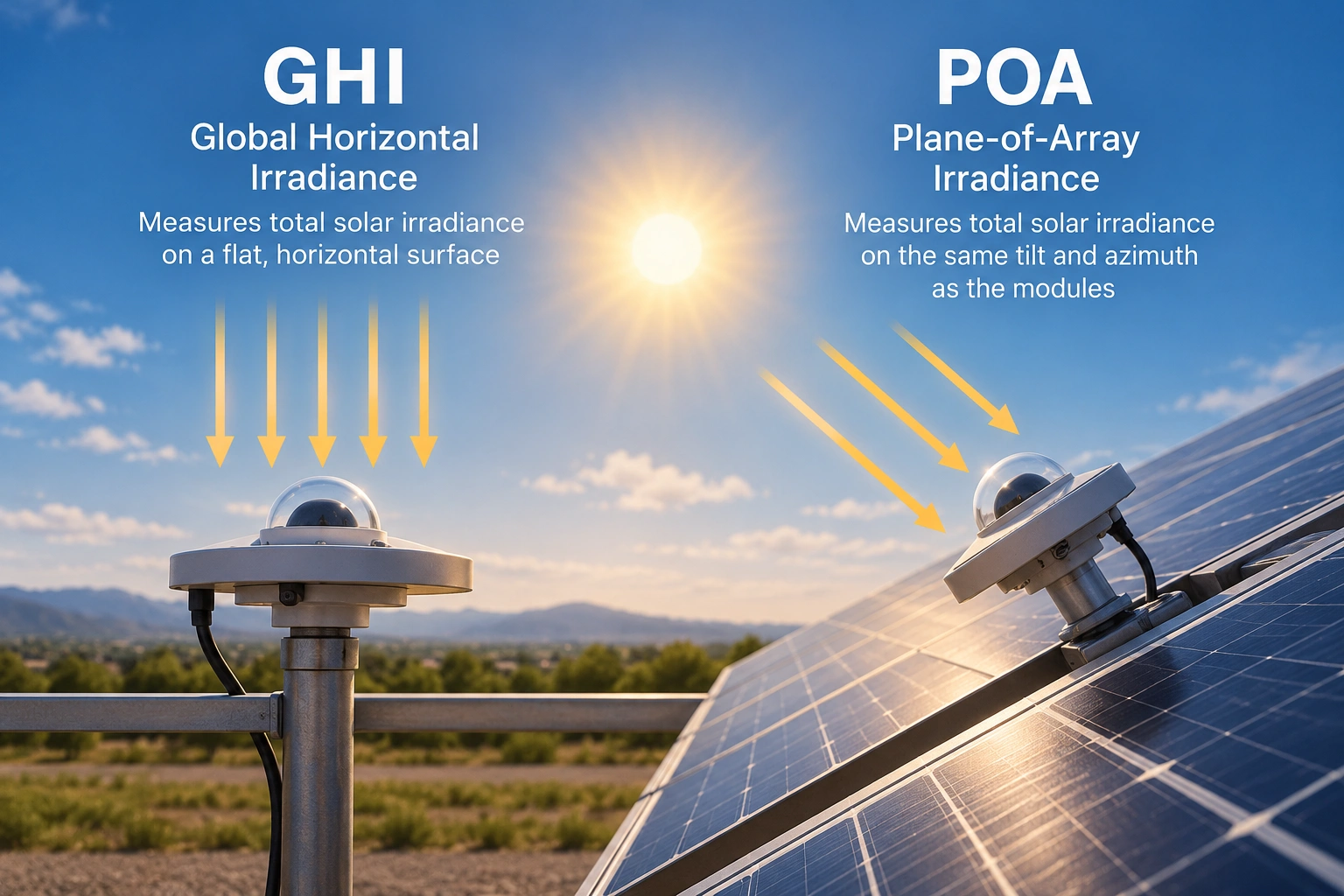
GHI is the total solar irradiance falling on a flat, horizontal surface, measured in watts per square meter (W/m²). It is the standard quantity reported by weather stations, satellite datasets, and typical meteorological year (TMY) files.
GHI combines two components:
- Direct normal irradiance (DNI): the beam of sunlight coming straight from the solar disk, projected onto the horizontal plane.
- Diffuse horizontal irradiance (DHI): sunlight scattered by clouds, aerosols, and the atmosphere, arriving from the whole sky dome.
They are related by a simple equation, where θz is the solar zenith angle:
GHI = DNI \cdot \cos\theta_z + DHIGHI is measured with a pyranometer mounted level, facing straight up. Because the sensor orientation is the same everywhere, GHI is easy to compare between sites, between years, and against long-term resource data. That comparability is its main strength.
What Is Plane-of-Array (POA) Irradiance?
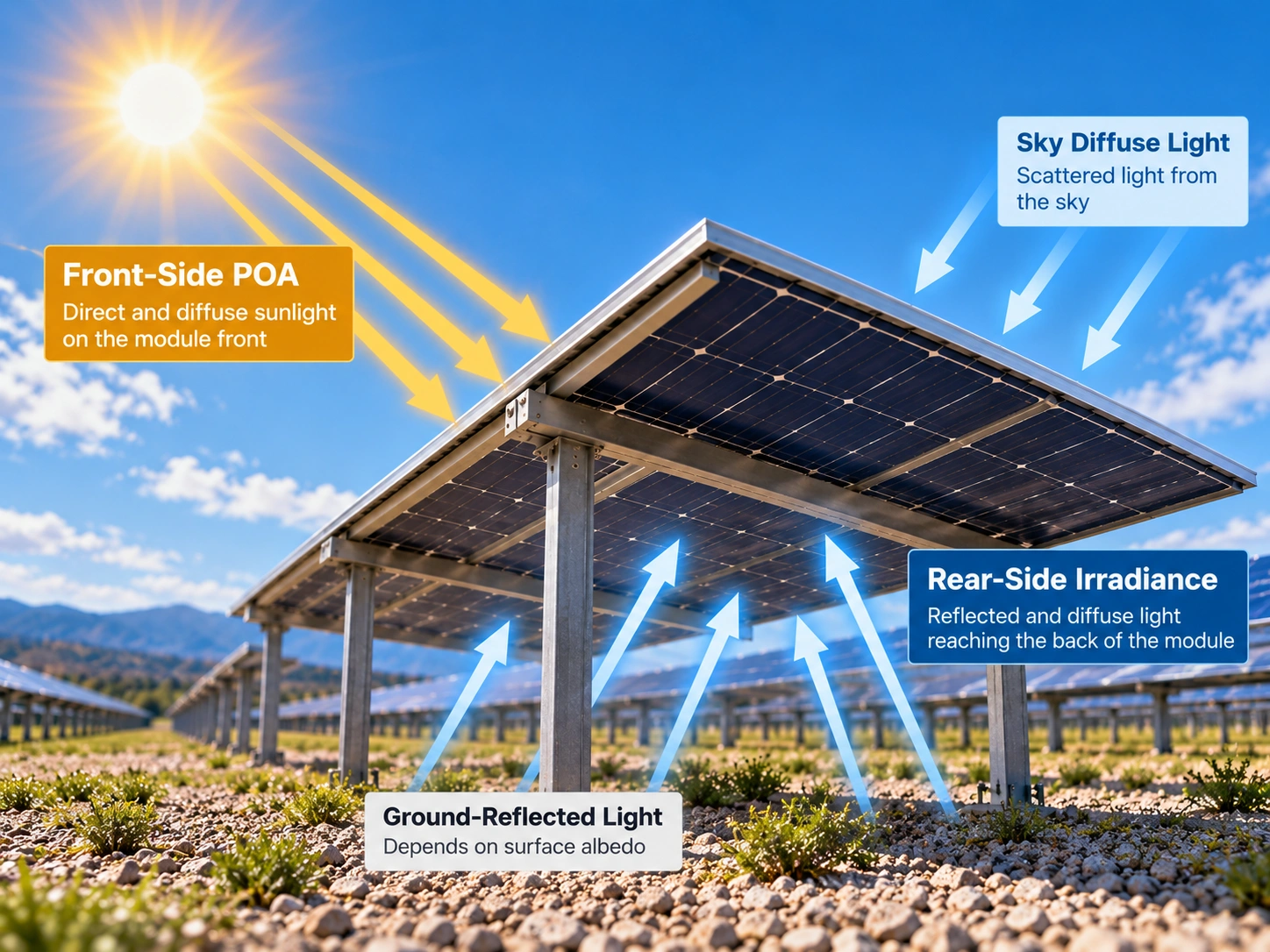
POA irradiance is the total solar irradiance striking the surface of the PV modules, at the same tilt and azimuth as the array. It is the sunlight the modules actually receive, so it is the most direct input for judging how well the plant converts light into energy.
POA irradiance has three components:
- Beam: direct sunlight, adjusted for the angle between the sun and the module surface.
- Sky diffuse: scattered light from the part of the sky the tilted module can see.
- Ground-reflected: light reflected from the ground and surroundings, which depends on albedo and tilt.
POA is measured with a pyranometer mounted in the same plane as the modules. On a fixed-tilt array, the sensor sits on a bracket at the array tilt. On a single-axis tracker, it is mounted on the torque tube or module rail so it follows the tracker’s rotation, including backtracking.
GHI vs. POA: Key Differences
GHI tells you what the sky delivered; POA tells you what your modules received. On a tilted or tracking array in clear conditions, POA is usually well above GHI, and the gap changes with season, time of day, and tracker position.
| Factor | GHI | POA |
|---|---|---|
| Sensor orientation | Level, facing up | Same tilt and azimuth as the modules |
| What it represents | Solar resource at the site | Sunlight actually reaching the modules |
| Main use | Resource assessment, weather comparison, model validation | Performance ratio, capacity tests, O&M diagnostics |
| Comparable across sites | Yes | Only for identical array geometry |
| Includes ground reflection | No | Yes |
| Sensitivity to mounting errors | Leveling | Tilt, azimuth, and tracker alignment |
| Needed for tracker sites | For reference | Essential; must rotate with the tracker |
Why You Can’t Simply Calculate POA from GHI
POA can be estimated from GHI with a transposition model, but the estimate adds uncertainty that direct measurement avoids. Models such as Hay-Davies and Perez take GHI, split it into beam and diffuse parts, then project each onto the tilted plane.
Each step brings its own error:
- Decomposition. Unless DNI and DHI are measured separately, they must be estimated from GHI alone, which is one of the least certain steps in solar modeling.
- Diffuse sky model. Diffuse light is not uniform across the sky. Different models treat circumsolar and horizon brightening differently and can disagree noticeably on the same data.
- Ground reflection. The model needs an albedo value, which often is assumed rather than measured and changes with snow, vegetation, and soil moisture.
- Tracker geometry. On tracking sites, the model needs the actual tracker angle at each timestep, including stow and backtracking events.
These errors are largest in exactly the conditions that matter for troubleshooting: partly cloudy skies, low sun angles, and winter months. For hour-by-hour performance analysis, a modeled POA value is a weaker yardstick than a measured one.
Which Should Your PV Site Measure?
If you have to prioritize, measure POA for performance and add GHI for context; most serious monitoring systems do both. The international standard for PV performance monitoring, IEC 61724-1, treats both measurements as part of a high-accuracy monitoring system.
The standard was revised in 2021 and now defines two monitoring classes, A and B. The former Class C became the new Class B. Class A, typical for utility-scale plants, calls for Class A pyranometers, and bifacial monitoring still includes both GHI and POA alongside rear-side measurements (EKO Instruments).
| Situation | What to measure | Why |
|---|---|---|
| Utility-scale plant, IEC 61724-1 Class A | POA and GHI, Class A pyranometers | Performance ratio on POA; GHI for model validation and satellite comparison |
| Single-axis tracker site | POA on the tracker, plus fixed GHI | Tracker errors show up only when POA and GHI are compared |
| Bifacial plant | POA, GHI, and rear-side or albedo | Rear gain can’t be verified without it |
| Commercial rooftop (C&I) | POA at minimum; GHI if budget allows | POA supports contract guarantees and O&M alerts |
| Pre-construction resource campaign | GHI, ideally with DNI and DHI | Array geometry isn’t final; GHI compares with long-term data |
| Capacity or acceptance test | POA | Test methods define expected output against in-plane irradiance |
The two measurements also check each other. When POA and GHI are logged side by side, a drifting sensor, a soiled dome, or a tracker stuck at the wrong angle shows up as a change in the POA-to-GHI ratio. With only one sensor, those faults can pass for real changes in plant output.
Installation Best Practices
A well-calibrated sensor still gives bad data if it is mounted in the wrong plane. Most field errors in POA and GHI data trace back to installation, not the instrument.
For GHI sensors
- Level the pyranometer using its built-in bubble level, and recheck after tightening the mounting bolts.
- Mount it above nearby obstructions so nothing shades the dome at any time of year.
- Keep it away from reflective surfaces, such as light-colored walls or module glass, that can add stray light.
For POA sensors
- Match the module tilt and azimuth closely. An inclinometer on the sensor bracket is quicker and more accurate than eyeballing it against the rail.
- On trackers, mount the sensor on the moving structure, not beside it, so it follows backtracking and stow.
- Place it where row-to-row shading at low sun angles matches the modules around it, not an unshaded end row.
- Avoid spots next to module frames or rails that cause partial shading of the dome.
For bifacial sites
- Add rear-side or albedo measurements, since front-side POA alone misses the energy the modules gain from reflected light.
- Locate rear sensors where ground cover is typical of the array, not over gravel roads or equipment pads.
For all sensors
- Clean domes on a regular schedule and log each cleaning, so soiling steps can be separated from real performance changes.
- Record the sensor serial number and sensitivity in the data logger, and update it after every recalibration.
Calibration: The Foundation Under Both Measurements
Whether you measure POA, GHI, or both, the data is only as good as each sensor’s calibration. Every pyranometer’s sensitivity drifts over time, and a POA sensor on a tracker sees more mechanical movement and heat cycling than a fixed GHI sensor.
Calibration matters even more when the two sensors are used to check each other. If the POA sensor was last calibrated three years ago and the GHI sensor last year, a change in their ratio could be sensor drift rather than a field problem. Calibrating both on the same schedule, to the same traceable reference, keeps the comparison meaningful.
At ISO-CAL North America, we calibrate pyranometers, pyrheliometers, and albedometers in our ISO/IEC 17025 accredited laboratory, with results traceable to the World Radiometric Reference. To learn more, read Class A vs. Class B vs. Class C Pyranometers: ISO 9060:2018 Explained and What Causes Calibration Drift?
Ready to calibrate your site’s POA and GHI sensors? Request a quote or start an RMA today.
Frequently Asked Questions
Is POA irradiance always higher than GHI?
Not always. On tilted or tracking arrays it is usually higher on clear days, especially in winter when the sun is low. Under heavy overcast, when most light is diffuse, POA can be close to or slightly below GHI.
Can I use satellite GHI data instead of an on-site sensor?
Satellite data is useful for long-term resource checks and gap-filling. It is less accurate hour by hour than a well-maintained on-site pyranometer, so it is a poor substitute for performance guarantees or capacity tests.
Can a reference cell measure POA instead of a pyranometer?
Yes, reference cells are also used for POA measurement. They respond to a narrower spectrum than a thermopile pyranometer, which makes them behave more like the modules but harder to compare with GHI and weather data.
How often should POA and GHI sensors be recalibrated?
Follow the manufacturer’s recommendation and your monitoring standard, which is commonly every one to two years. Calibrate POA and GHI sensors on the same schedule so their ratio remains a reliable diagnostic.