
Class A vs. Class B vs. Class C Pyranometers: ISO 9060:2018 Explained
If you are setting up a solar monitoring station, evaluating a utility-scale PV plant, or managing an agricultural weather network, one of the first decisions you must make is selecting the right pyranometer. However, glancing at a manufacturer’s spec sheet can quickly become confusing when you are hit with terms like “Class A,” “Spectrally Flat,” or “Secondary Standard.”
These terms all trace back to ISO 9060, the international standard that classifies solar radiometers based on their accuracy and performance.
In 2018, the International Organization for Standardization (ISO) updated this standard, completely overhauling the naming conventions to make them more intuitive. In this guide, we will break down the differences between Class A, Class B, and Class C pyranometers under the ISO 9060:2018 standard so you can choose the exact right instrument for your application.
What Changed in ISO 9060:2018?
Before 2018, the industry used ISO 9060:1990, which classified sensors using somewhat confusing terminology: Secondary Standard, First Class, and Second Class.
To align better with modern metrology and eliminate the confusion of a “First Class” sensor actually being the second-best option, the 2018 update introduced a straightforward alphabetical hierarchy. It also introduced a new sub-category (“Spectrally Flat”) to account for the growing use of advanced thermopile and optical technologies.
Here is how the old terminology maps to the new ISO 9060:2018 standard:
| ISO 9060:2018 (New Standard) | ISO 9060:1990 (Old Standard) | General Accuracy Level |
| Class A | Secondary Standard | Highest Precision |
| Class B | First Class | Good / Intermediate |
| Class C | Second Class | Moderate / Basic |
The Breakdown: Class A vs. Class B vs. Class C
Choosing between the three classes ultimately comes down to your required measurement uncertainty and your budget. Here is a detailed look at what each class offers.
Class A Pyranometers (Highest Precision)
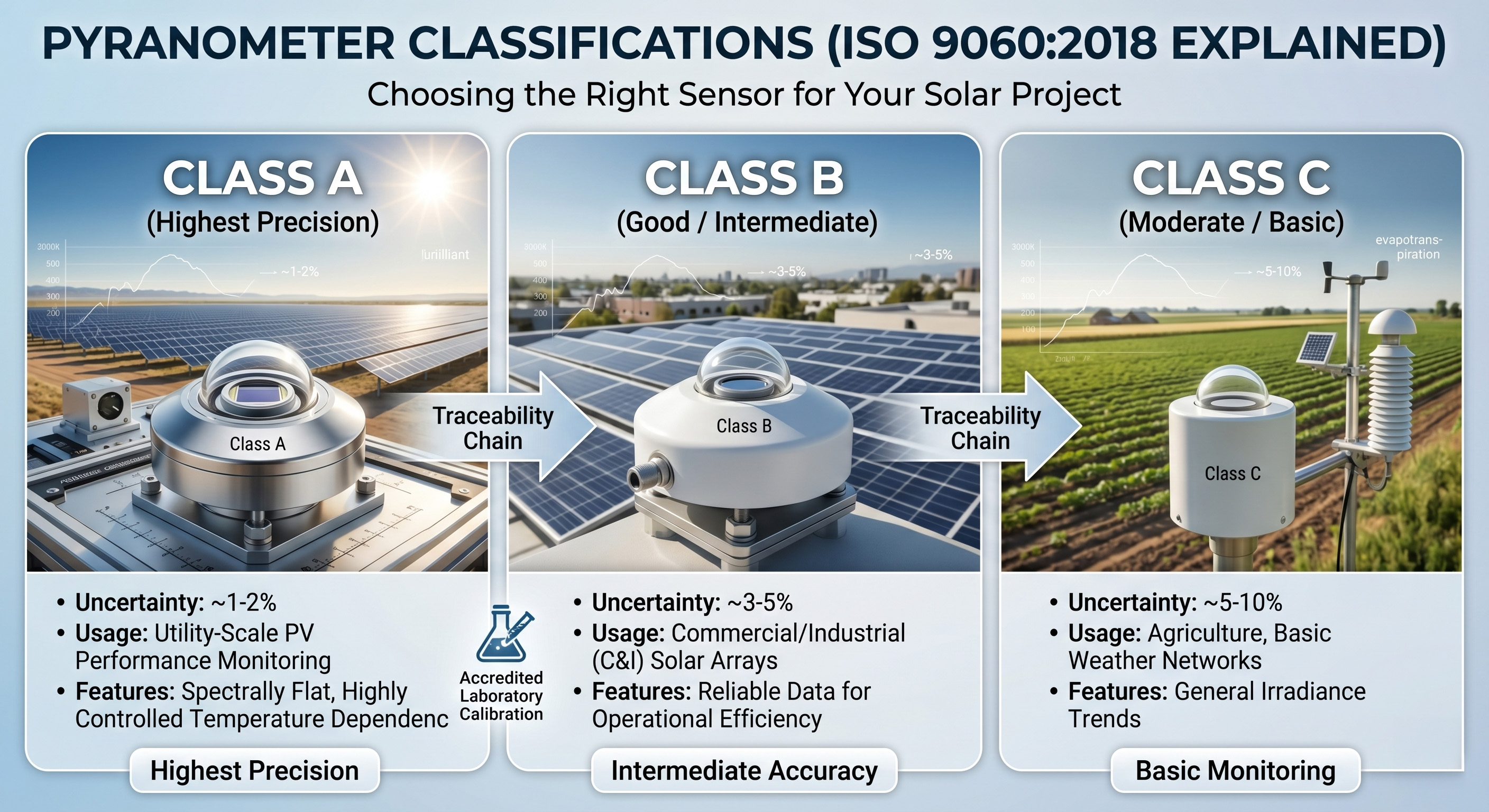
Class A pyranometers represent the gold standard in solar radiation measurement. These instruments are manufactured to the tightest tolerances, featuring high-quality quartz domes (often dual-dome setups to minimize thermal offsets), superior temperature dependence, and minimal directional response errors (cosine errors).
- Estimated Uncertainty: ~1% to 2%
- Best Used For: * Utility-scale solar power plant monitoring (Performance Ratio calculations).
- Scientific and meteorological climate research.
- Serving as a transfer standard in calibration laboratories.
- The Bottom Line: If financial guarantees, strict SLAs, or high-level scientific publications depend on your data, Class A is mandatory.
Class B Pyranometers (General Purpose)
Class B sensors provide a reliable middle ground. They are highly accurate but have slightly wider tolerances for thermal offsets and temperature dependence compared to Class A models. They typically utilize single glass domes rather than dual domes.
- Estimated Uncertainty: ~3% to 5%
- Best Used For:
- Commercial and industrial (C&I) solar arrays.
- Standard meteorological networks.
- Routine building automation and HVAC efficiency monitoring.
- The Bottom Line: Class B is perfect for applications that require reliable, actionable solar data without the premium price tag of laboratory-grade instrumentation.
Class C Pyranometers (Basic Monitoring)
Class C pyranometers are entry-level sensors. While they use the same basic principles to measure irradiance, their build materials and thermal characteristics allow for a higher degree of measurement uncertainty.
- Estimated Uncertainty: ~5% to 10%
- Best Used For:
- Pyranometer calibration for agriculture (e.g., estimating evapotranspiration in farming).
- Basic hobbyist weather stations.
- Educational purposes.
- The Bottom Line: Use Class C when you need to know general solar trends (e.g., “Is it sunny or cloudy?”), but do not rely on it for strict PV performance monitoring or financial reporting.
What Does “Spectrally Flat” Mean?
When shopping for sensors today, you will frequently see labels like “Spectrally Flat Class A.”
This is a specific sub-category introduced in the 2018 update. A “spectrally flat” pyranometer has a highly uniform spectral response across the entire solar spectrum (from UV to near-infrared). This means the sensor’s accuracy does not change depending on whether it is measuring a clear blue sky, heavy cloud cover, or the specific spectrum of light reflected off a building. High-quality thermopile pyranometers are almost always spectrally flat, whereas many silicon photodiode sensors are not.
Why Calibration Outweighs Classification
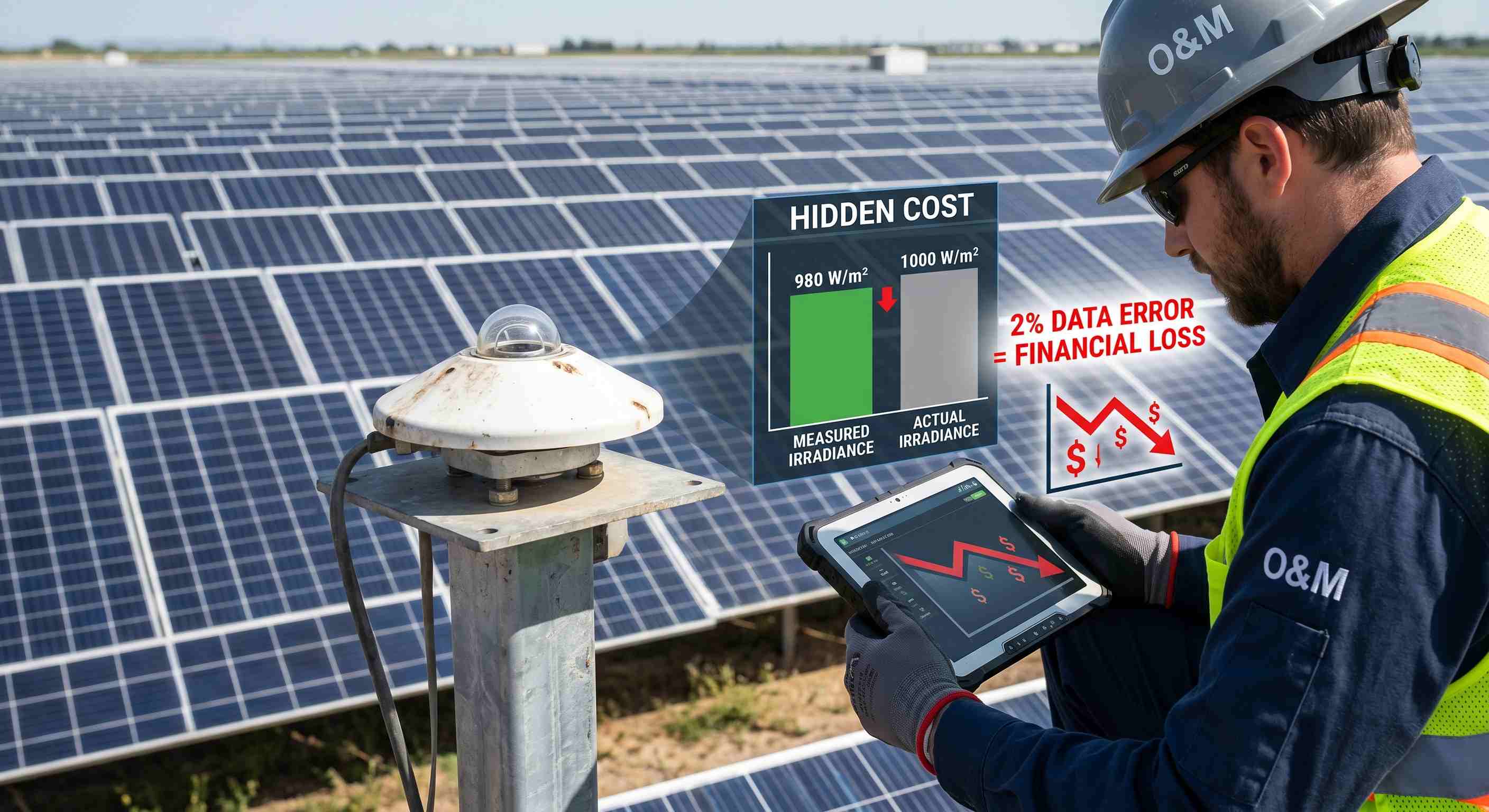
You can purchase the most expensive, Spectrally Flat Class A pyranometer on the market, but if it is not regularly calibrated, its data will eventually become less reliable than a well-maintained Class C sensor.
Over time, prolonged exposure to UV radiation and temperature extremes will cause the sensor’s sensitivity to drift. To maintain standard compliancy and ensure your data remains valid, you must strictly adhere to industry calibration schedules.
When you send your instrument to a lab, ensure they are utilizing proper procedures, such as the pyranometer calibration methods explained in ISO 9847 vs ISO 9060.
Maintain Your Sensor’s Accuracy with ISO-CAL North America
Whether you are operating a fleet of Class A sensors for a utility-scale solar farm or maintaining Class C sensors for agricultural networks, accurate data requires accredited calibration.
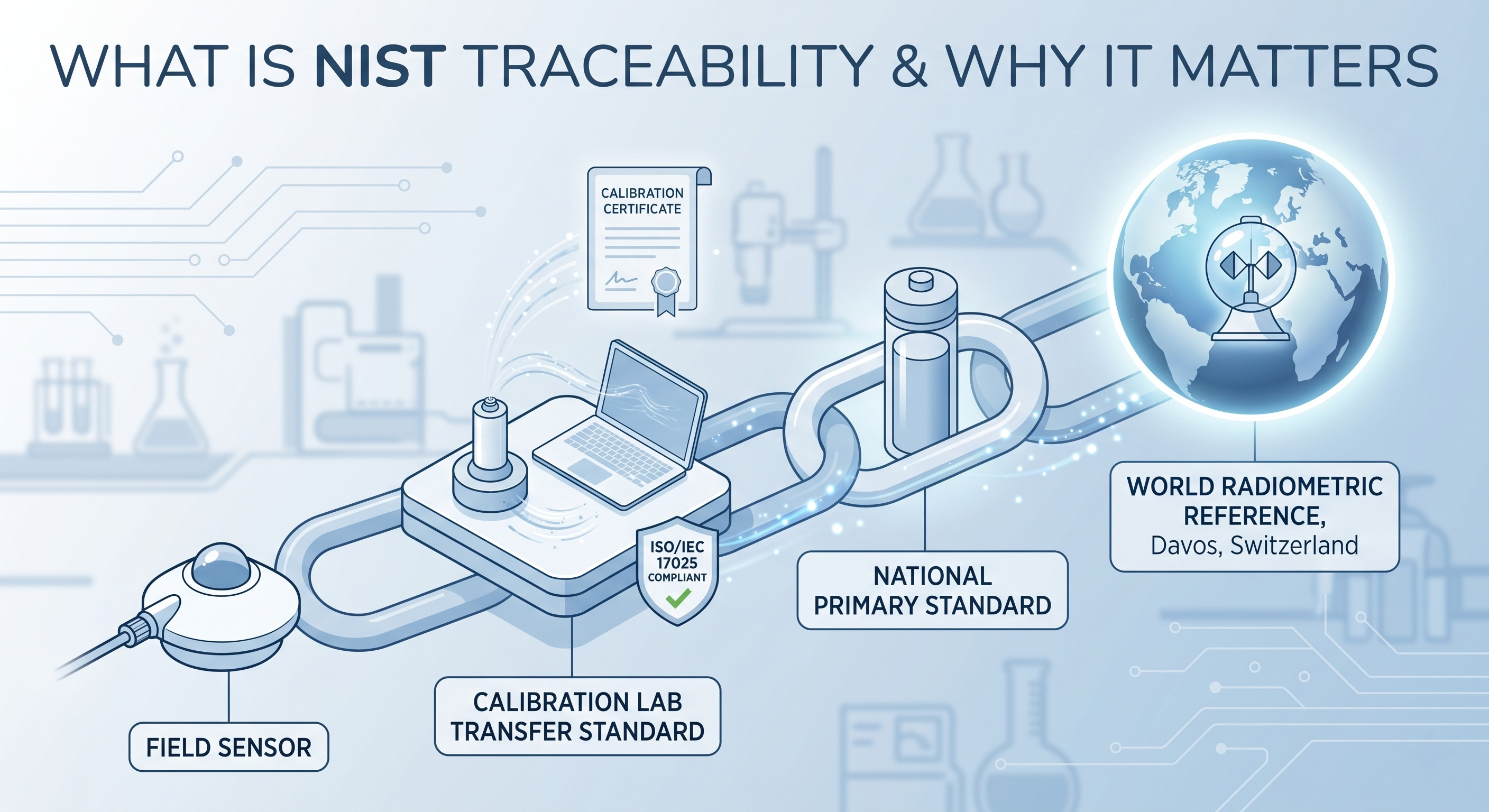
ISO-CAL North America offers ISO/IEC 17025 accredited radiometer calibration services for all classes of pyranometers. Our highly controlled indoor and outdoor testbeds ensure your instruments are returned with precise, NIST-traceable calibration certificates.
Contact us today to schedule your pyranometer calibration and protect the integrity of your solar data.