

The Hidden Costs of Skipping Pyranometer Calibration on Commercial Solar Farms
For commercial solar farms, data is just as valuable as the electricity generated. Facility managers and Operations & Maintenance (O&M) teams rely on pyranometers to measure incoming solar irradiance. This data is the baseline for calculating a plant’s Performance Ratio (PR)—the ultimate metric that tells you if your solar farm is operating optimally or losing money.
However, once installed, these highly sensitive instruments are frequently left on the roof or in the field for years without a second thought.
Skipping regular maintenance and calibration might seem like a way to save on short-term operational costs, but the long-term financial consequences can be severe. Let’s break down the hidden costs of ignoring your pyranometer calibration schedule and how a seemingly tiny measurement error can lead to massive financial losses.
The Ripple Effect of Inaccurate Solar Data
A pyranometer works by utilizing a black thermopile sensor to absorb solar radiation. Over time, constant exposure to harsh UV light, extreme temperatures, and environmental contaminants causes the sensor’s sensitivity to drift. This drift usually results in the instrument reading lower irradiance than what is actually hitting the solar arrays.
The cost of inaccurate solar data creates a dangerous ripple effect across your entire operation:
- Masked Equipment Failures: If your pyranometer reading is artificially low by 3%, your expected energy yield calculation drops by 3%. If your solar panels concurrently suffer a 3% efficiency loss due to soiling, string failures, or inverter clipping, your system will look like it is performing perfectly according to the PR. You are essentially flying blind, unaware of a very real, fixable revenue leak.
- False Alarms and Wasted Truck Rolls: Conversely, if data anomalies cause your system to report an artificial drop in PR, O&M teams might dispatch technicians to troubleshoot “failing” inverters or panels that are actually working fine. Unnecessary truck rolls eat directly into your O&M profit margins.
- Breach of Performance Guarantees: Many O&M contracts include strict performance guarantees or Service Level Agreements (SLAs). Inaccurate irradiance data can falsely indicate that you are failing to meet these contractual obligations, leading to financial penalties or damaged client trust.
This is exactly why we highlight the importance of calibration for PV system O&M providers. Your decisions are only as good as your data.
Quantifying the Solar Farm Efficiency Loss
Let’s look at a conservative hypothetical scenario to understand the financial impact.
Imagine a 50 Megawatt (MW) commercial solar farm that generates roughly $5,000,000 in annual revenue.
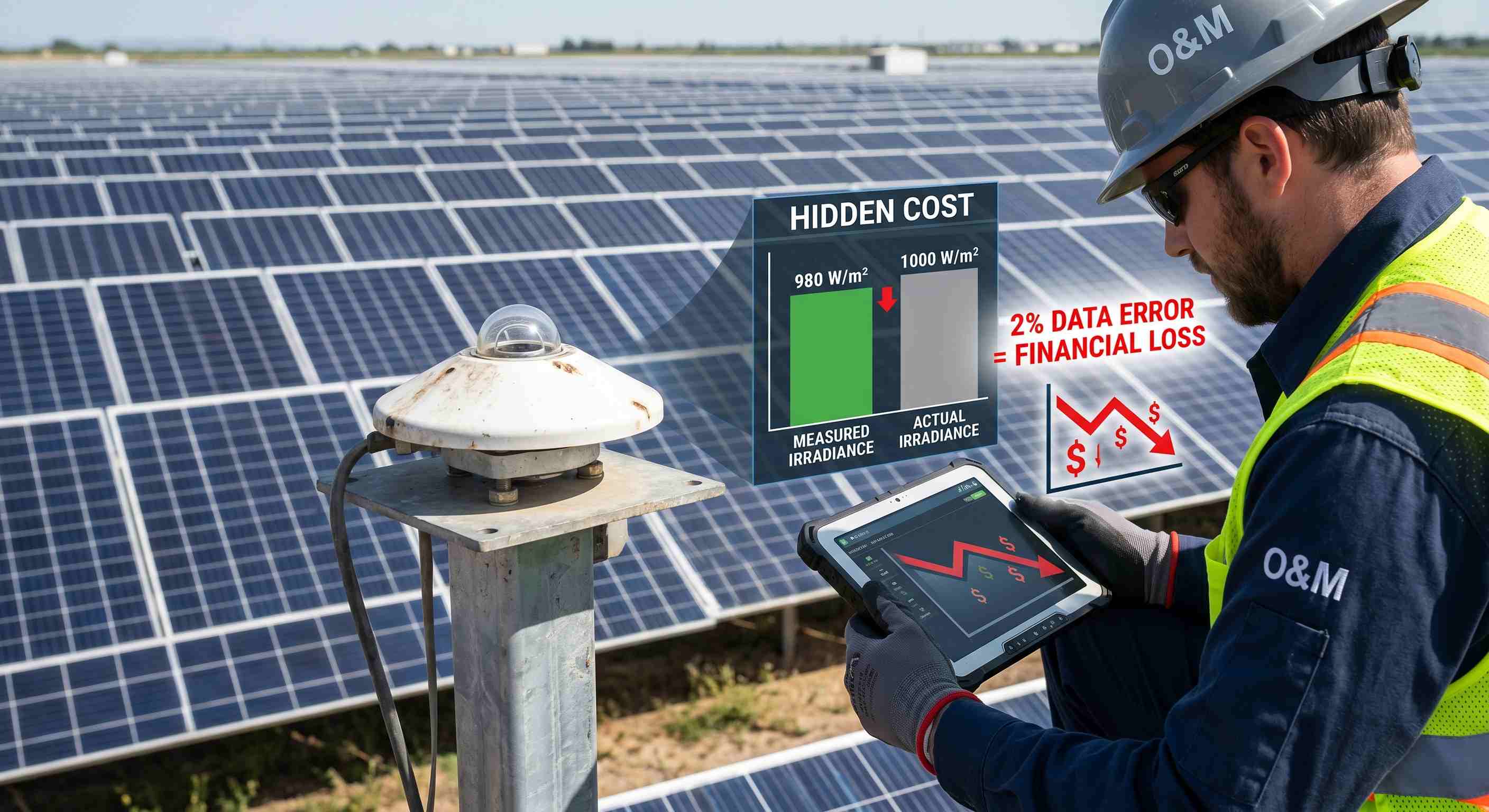
Because of an uncalibrated, drifting pyranometer, the measured irradiance is off by just 2%. Because this error masks a real 2% underperformance issue in the field (such as severe panel soiling that goes uncleaned), the plant loses 2% of its actual potential yield.
- 2% of $5,000,000 = $100,000 lost in a single year.
When you compare a six-figure loss against the minimal cost of sending a sensor to an accredited lab, the ROI of calibration becomes undeniable.
What is the Recommended Pyranometer Calibration Frequency?
The only way to prevent these hidden costs is to stick to a strict maintenance schedule. But what is the standard pyranometer calibration frequency?
- Industry Standard: The vast majority of manufacturers and industry standards recommend recalibrating pyranometers every 1 to 2 years.
- High-Stakes Environments: For utility-scale farms with stringent performance guarantees, annual calibration is highly recommended.
- Monitoring for Drift: You should also continuously monitor your data for signs your pyranometer needs calibration, such as unexplainable discrepancies between parallel sensors or impossible night-time offsets.
When sending your instruments in, ensure the laboratory adheres strictly to pyranometer calibration methods explained in ISO 9847 vs ISO 9060 to guarantee traceable, compliant results.
Protect Your Performance Ratio with ISO-CAL
Ignoring sensor drift is a gamble that commercial solar operators cannot afford to take. By maintaining a proactive calibration schedule, you protect your plant’s efficiency, validate your O&M efforts, and secure your revenue stream.
ISO-CAL North America operates an ISO/IEC 17025 accredited laboratory specializing in solar radiation sensors. We provide fast, reliable, and compliant calibration services to keep your solar farm’s data accurate and actionable.
Contact us today to schedule your pyranometer calibration and stop letting bad data drain your profits.