
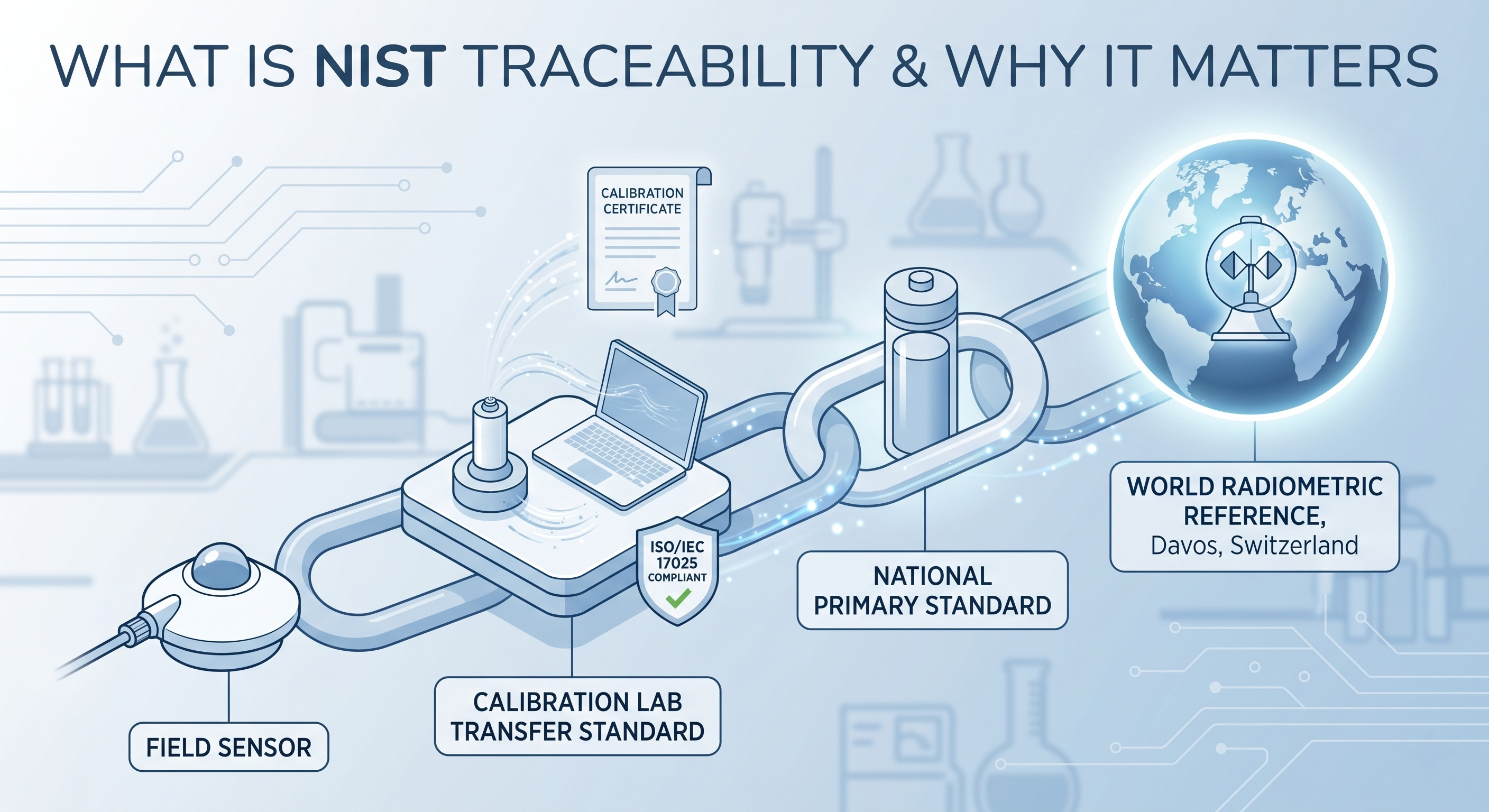

What is NIST Traceability and Why Does It Matter for Solar Sensors?
When reviewing calibration certificates for pyranometers, pyrheliometers, or heat flux sensors, you will almost certainly encounter the phrase “NIST Traceable.” For facility managers, solar farm operators, and test engineers, this isn’t just an industry buzzword—it’s a critical requirement that guarantees the validity of your data.
But what exactly does this term mean, and why is a NIST calibration certificate so important for your solar and thermal measurement instruments?
In this guide, we will break down the concept of metrological traceability, explain how it applies to solar sensors, and highlight why it is essential for compliance, performance, and bankability.
What is NIST Traceability?
NIST stands for the National Institute of Standards and Technology, a federal agency within the U.S. Department of Commerce. NIST is responsible for developing and maintaining the national standards of measurement (such as temperature, voltage, and mass) and ensuring they align with the International System of Units (SI).
NIST Traceability (often referred to broadly as metrological traceability) refers to an unbroken chain of measurements or calibrations that link your specific instrument back to these recognized national or international standards.
According to official metrology guidelines, a traceable solar measurement must include:
- An unbroken chain of comparisons: The calibration must definitively link back to a primary standard.
- Documented measurement uncertainty: Each step in the traceability chain must have a calculated and stated uncertainty.
- Documented procedures: Calibrations must be performed following generally acknowledged and approved methods.
- Demonstrated Competence: The laboratory performing the calibration must demonstrate technical competence, typically through formal accreditation.
For a deeper dive into these core concepts, explore our guide on calibration fundamentals: accuracy, traceability, and measurement uncertainty.
The Traceability Chain for Solar Sensors
For solar radiation sensors specifically (like pyranometers and pyrheliometers), the ultimate global standard is the World Radiometric Reference (WRR), maintained by the World Radiation Center (PMOD/WRC) in Davos, Switzerland.
In North America, the traceability chain usually looks like this:
- The Primary Standard: The WRR in Switzerland.
- National Reference Standard: Facilities like the National Renewable Energy Laboratory (NREL) calibrate their reference instruments directly against the WRR.
- Secondary/Transfer Standards: Accredited calibration laboratories (like ISO-CAL North America) calibrate their high-precision, indoor and outdoor reference sensors against NREL or NIST standards.
- Your Instrument: Your field sensor is calibrated against the laboratory’s transfer standard.
Because every single step is documented and accounted for, the calibration of your field pyranometer is directly traceable back to the highest international radiometric authorities.
Why NIST Traceability Matters for Solar Operations
Operating with sensors that lack proper traceability is a major financial and operational risk. Here is why investing in traceable calibration is non-negotiable.
1. Bankability and Performance Guarantees
For utility-scale commercial solar farms, energy production dictates revenue. Operations and Maintenance (O&M) teams rely on highly accurate irradiance data to calculate the Performance Ratio (PR) of a plant. If your solar data is inaccurate, you cannot accurately assess if your panels are underperforming or if you are meeting the strict Service Level Agreements (SLAs) set by investors. Traceability ensures your baseline data is legally and financially defensible.
2. Regulatory and Quality Compliance
Most large-scale engineering, aerospace, and energy projects operate under strict quality management systems. Whether you are conducting fire safety testing with heat flux sensors or monitoring a PV array, your equipment must comply with industry standards. Many contracts explicitly require a NIST-traceable calibration certificate to satisfy ISO 9001 and other calibration standards. Without traceability, auditors can—and will—reject your operational data.
3. Known Measurement Uncertainty
All measurements have some degree of doubt. Traceability requires that every step in the calibration chain quantifies this doubt. Knowing the exact uncertainty of your pyranometer allows engineers to calculate safe margins and accurate yield estimates. To understand how this impacts your day-to-day data, read more about understanding measurement uncertainty in calibration results.
NIST Traceable vs. ISO/IEC 17025 Accredited: What’s the Difference?
It is a common misconception that “NIST Traceable” and “ISO/IEC 17025 Accredited” mean the exact same thing. While they are closely related, they represent different levels of quality assurance:
- NIST Traceable: This means the measurement equipment used to calibrate your sensor traces back to NIST or WRR standards. However, claiming traceability alone does not inherently guarantee that the laboratory performing the work followed strict quality controls or correctly calculated uncertainty.
- ISO/IEC 17025 Accredited: This is a formal, third-party recognition of a laboratory’s competence. An ISO 17025 accredited lab uses NIST-traceable standards and has proven its technical proficiency, rigorous documentation processes, and quality management systems to an external, independent auditor.
For critical measurements, a simple traceability claim isn’t always enough. You need the full, documented assurance that comes with the definition and importance of ISO 17025 accreditation. (You can learn more in our essential guide to calibration lab standards).
Secure Your Data with Traceable Calibration
At ISO-CAL North America, we don’t just provide a sticker; we provide absolute peace of mind. Our radiometer calibration services are fully ISO/IEC 17025 accredited, ensuring that every pyranometer, pyrheliometer, and heat flux sensor we calibrate maintains an unbroken, strictly documented chain of metrological traceability.
Don’t leave your performance data to chance. Contact us today to schedule your fully traceable solar sensor calibration.