
What Is a Pyrgeometer? Measuring Longwave Radiation
Introduction
A pyrgeometer measures longwave infrared radiation, the heat radiated by the atmosphere, clouds, and the ground. A pyranometer measures sunlight. A pyrgeometer measures the thermal radiation that is present day and night, whether or not the sun is shining.
That makes it the missing half of the radiation budget. Sunlight is only part of the energy reaching a surface. The rest arrives as longwave radiation from the sky, and every surface loses energy by radiating longwave back out. Measuring both gives you net radiation, the quantity that drives surface heating, evaporation, frost, and the operating temperature of anything left outdoors, PV modules included.
This guide explains how longwave radiation differs from sunlight, how a pyrgeometer works, where it’s used, what makes it tricky to measure well, and how it’s calibrated.
Shortwave vs. Longwave Radiation
Radiation is split into shortwave and longwave by its source. The sun is very hot, so it radiates mostly at short wavelengths, below about 3 µm. The Earth, the atmosphere, and clouds are much cooler, so they radiate at long infrared wavelengths, roughly 4 to 50 µm. The two bands barely overlap, which lets each be measured separately.
| Pyranometer | Pyrgeometer | |
|---|---|---|
| Measures | Shortwave (solar) radiation | Longwave (thermal infrared) radiation |
| Typical spectral range | About 0.3 to 3 µm | About 4.5 to 42 µm |
| Source | The sun, direct and diffuse | Atmosphere, clouds, ground |
| Present at night | No | Yes |
| Window material | Glass or quartz dome | Coated silicon window that blocks sunlight |
| Typical downward reading | 0 to about 1,400 W/m² | Roughly 150 to 450 W/m², day and night |
The spectral range shown is typical of research-grade instruments such as EKO’s MS-21 (EKO Instruments).
Downward longwave radiation depends on air temperature, humidity, and cloud cover. A cloudy, humid night sends much more longwave radiation down than a clear, dry one. That is why clear nights are colder, and why frost and dew form under clear skies.
How a Pyrgeometer Works
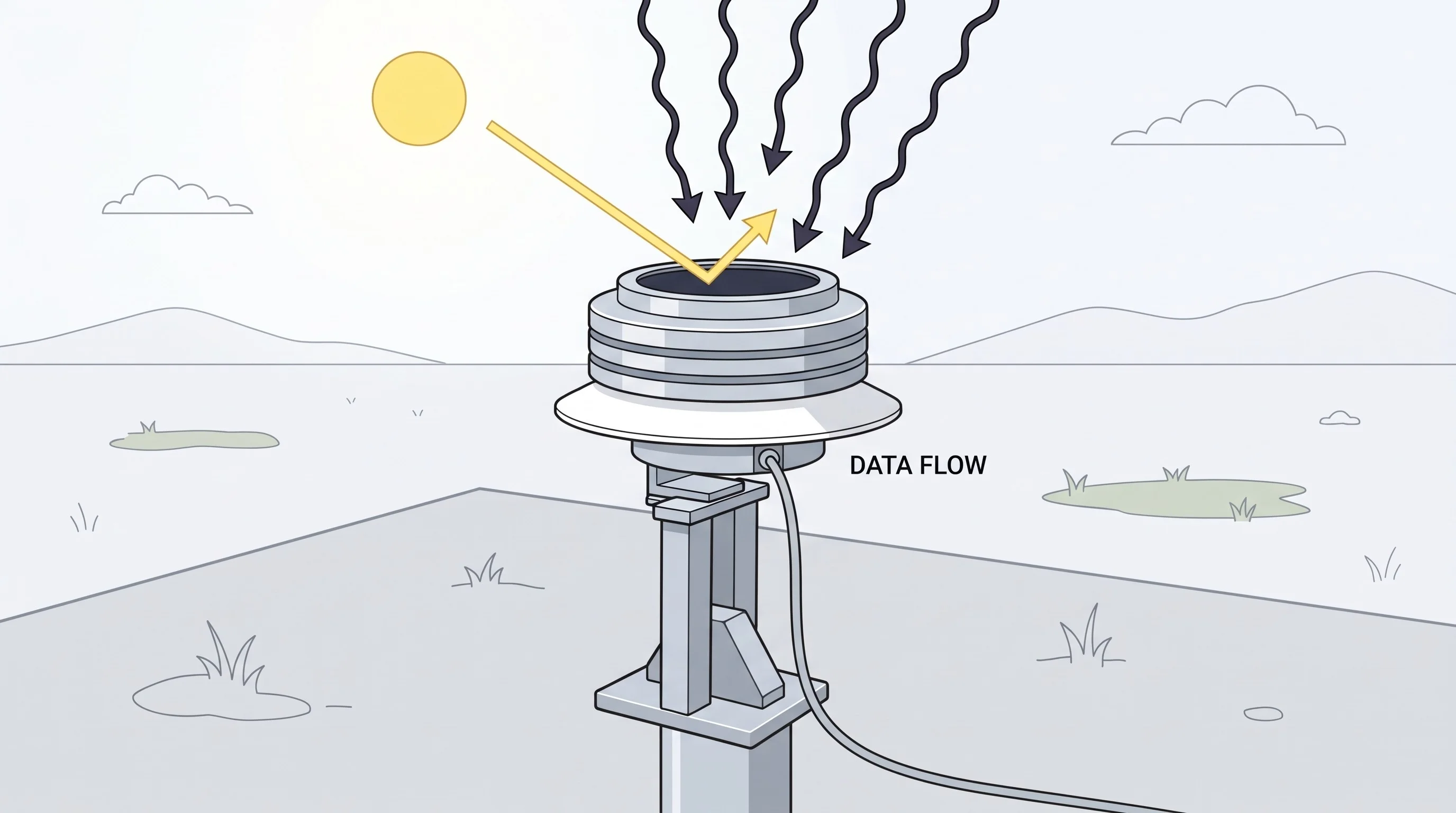
A pyrgeometer measures the difference between the longwave radiation arriving from the sky and the radiation its own sensor emits. It then adds the sensor’s own emission back in to find the incoming value.
The instrument has three key parts:
- A filtered window. A silicon window, coated with an interference filter, blocks solar wavelengths below about 4.5 µm while passing longwave infrared. This lets the instrument work in daylight without a shading device.
- A thermopile detector. As in a thermopile pyranometer, a blackened surface absorbs radiation and produces a small voltage. In a pyrgeometer, that voltage reflects the net exchange: positive when the sky radiates more than the sensor, negative when the sensor radiates more than the sky.
- A body temperature sensor. Usually a Pt-100 or thermistor, this measures the instrument’s own temperature so its emitted radiation can be calculated.
In its simplest form, incoming longwave irradiance is calculated as:
E = U / S + σ × T⁴
where E is the incoming longwave irradiance in W/m², U is the thermopile voltage, S is the sensitivity from the calibration certificate, σ is the Stefan-Boltzmann constant (5.67 × 10⁻⁸ W/m²K⁴), and T is the instrument body temperature in kelvin.
The first term is the net exchange. The second is the radiation a blackbody at the instrument’s temperature would emit. Because the second term is large, typically 300 to 450 W/m², even a small error in body temperature makes a noticeable difference to the result. Some manufacturers add correction terms for dome temperature, so always use the equation given in your instrument’s manual.
Where Pyrgeometers Are Used
Pyrgeometers are used wherever the full energy balance of a surface matters, not just the sunlight falling on it.
- Climate and atmospheric research. Long-term downward longwave measurements track changes in cloud cover, humidity, and greenhouse forcing. High-quality radiation networks pair pyrgeometers with pyranometers and pyrheliometers.
- Net radiation measurement. An upward-facing and a downward-facing pyrgeometer, combined with a pair of pyranometers, measure all four components of net radiation. This is the basis of four-component net radiometers.
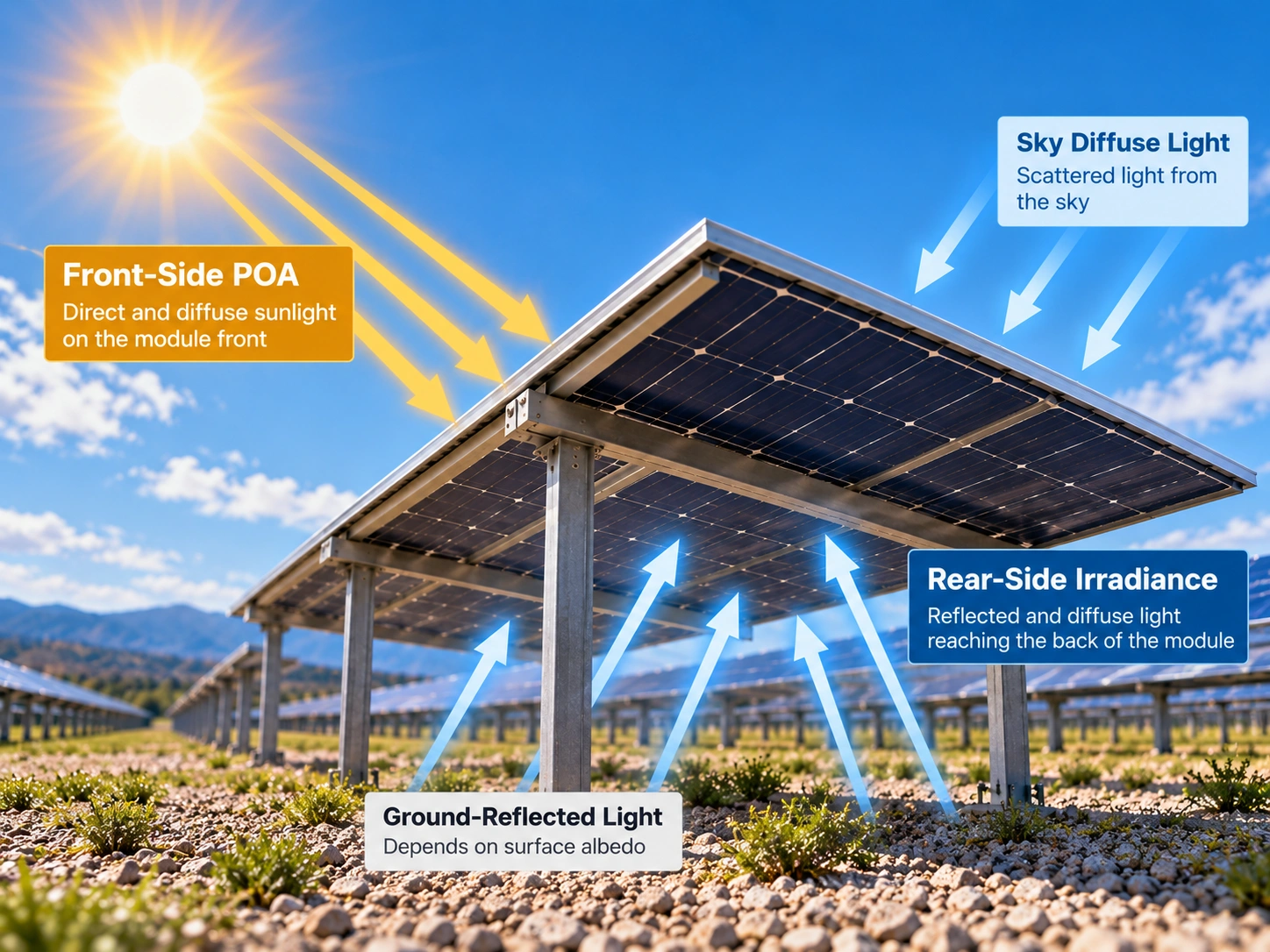
- Solar PV performance and module temperature. Module temperature depends partly on how much heat the panels radiate to the sky. Sky temperature derived from downward longwave improves module temperature models, especially at night and under clear skies.
- Agriculture and frost forecasting. Clear nights with low downward longwave are when crops are most at risk of radiative frost. Pyrgeometers help growers and forecasters anticipate it.
- Building and materials research. Roofs, facades, and radiative cooling materials lose heat to the sky by longwave radiation. Measuring it is essential for evaluating cool roofs and passive cooling surfaces. Our post on Understanding Roof Temperature Measurement covers related ground.
- Snow and hydrology. Longwave radiation is a major term in snowmelt models, particularly under cloud.
What Makes Longwave Hard to Measure
The biggest error sources in pyrgeometer data come from the instrument’s own temperature, not from the sky. Because the measurement depends on the sensor’s own emission, anything that heats or cools parts of the instrument unevenly shows up as error.
- Window heating. Sunlight warms the silicon window during the day, and the warm window radiates onto the detector, making the reading too high. Research-grade instruments are designed to minimize this effect. For example, EKO specifies a window heating offset below 4 W/m² for its MS-21 (EKO Instruments). Lower-cost models can be considerably higher.
- Body temperature errors. The body temperature term is large, so a body sensor that is miscalibrated or poorly coupled to the detector causes a direct error. A 1 °C error near room temperature shifts the result by roughly 5 to 6 W/m².
- Temperature gradients. Rapid temperature changes, such as at sunrise, during rain, or in gusty wind, create gradients between the window, body, and detector that the simple equation doesn’t account for.
- Dew, frost, and rain. Water on the window absorbs and emits infrared strongly, distorting readings. Ventilators and heaters reduce this, although heaters must be designed so they don’t themselves bias the reading.
- Shading and field of view. For downward longwave, the instrument should see the whole sky. Nearby buildings and trees emit longwave at their own temperature, adding to the reading.
- Ventilation. Ventilating the instrument keeps the window and body closer in temperature and reduces both dew and window heating.
Many of these effects are similar to those discussed in How Temperature Gradients Affect Thermal Measurements.
Calibration and Traceability
Pyrgeometer calibration is traceable to a different reference than pyranometer calibration. Solar instruments trace back to the World Radiometric Reference. Longwave instruments trace back to the World Infrared Standard Group (WISG), a set of reference pyrgeometers maintained by the World Radiation Center in Davos, Switzerland. Manufacturers such as EKO state WISG traceability for their research-grade pyrgeometers (EKO Instruments).
A pyrgeometer calibration typically determines:
- Sensitivity of the thermopile, in µV per W/m².
- Body temperature sensor accuracy, since its error feeds directly into the result.
- Correction coefficients for dome or window effects, where the instrument design uses them.
Calibration can be done outdoors, by comparison with reference pyrgeometers under the night sky, or indoors, using blackbody sources at controlled temperatures. Each approach has trade-offs. Outdoor comparison reproduces real sky conditions, while indoor blackbody methods give better control over temperatures. Our posts on What Is a Blackbody? and How Reference Blackbodies Are Characterized explain the blackbody side.
As with pyranometers, pyrgeometer sensitivity drifts with UV exposure, weathering of the window coating, and age. Recalibration intervals of one to two years are common, but check the manufacturer’s recommendation and any network or project requirements.
At ISO-CAL North America, we specialize in ISO/IEC 17025 accredited calibration of radiometric instruments.
Questions about calibrating your pyrgeometers or net radiometers? Contact us or start an RMA today.
Frequently Asked Questions
Can a pyranometer measure longwave radiation?
No. A pyranometer’s glass or quartz dome blocks almost all longwave infrared, so it only sees sunlight. You need a pyrgeometer, or a net radiometer that includes one, to measure longwave.
Why can a pyrgeometer’s thermopile output be negative?
The thermopile measures the net exchange between the sky and the sensor. On a clear night the sky is much colder than the instrument, so the sensor radiates more than it receives and the voltage goes negative. Adding the body emission term gives the positive incoming value.
Do I need a shading device for a pyrgeometer?
Generally not, since the filtered window blocks sunlight. Some high-accuracy research stations still shade the instrument to reduce window heating further.
What is “sky temperature”?
It is the temperature of a blackbody that would emit the same downward longwave radiation as the sky. It’s calculated from pyrgeometer data and is often used in PV module and building thermal models.
How is a pyrgeometer different from an infrared thermometer?
An infrared thermometer measures a narrow band of infrared from a small spot, to estimate surface temperature. A pyrgeometer measures broadband longwave irradiance from the whole hemisphere, in W/m².