
Understanding Calibration Traceability to NIST
Whether you’re calibrating a pyranometer, heat flux sensor, pyrheliometer, or other radiometric instrument, one phrase appears on nearly every calibration certificate: NIST traceability.
But what does “traceable to NIST” actually mean?
Contrary to popular belief, it doesn’t necessarily mean your instrument was calibrated by the National Institute of Standards and Technology (NIST). Instead, it means your calibration results can be linked through an unbroken chain of documented comparisons back to national measurement standards maintained by NIST.
Understanding calibration traceability is essential for ensuring confidence in measurement results, meeting quality requirements, and complying with internationally recognized standards such as ISO/IEC 17025.
What Is Calibration Traceability?
Calibration traceability is the documented chain that connects a measurement back to a recognized national or international standard.
Each calibration in the chain contributes a known measurement uncertainty, creating a transparent record showing exactly how a measurement was established.
Rather than relying on assumptions or manufacturer specifications alone, traceability provides objective evidence that measurements are based on recognized reference standards.
What Is NIST?
The National Institute of Standards and Technology (NIST) is a U.S. government agency responsible for maintaining national measurement standards across numerous scientific disciplines.
NIST develops highly accurate reference standards that calibration laboratories use to verify their own reference instruments.
Because NIST represents the highest level of measurement authority in the United States, many industries require calibration results to be traceable back to NIST.
For more information, visit the National Institute of Standards and Technology (NIST) website.
How Traceability Works
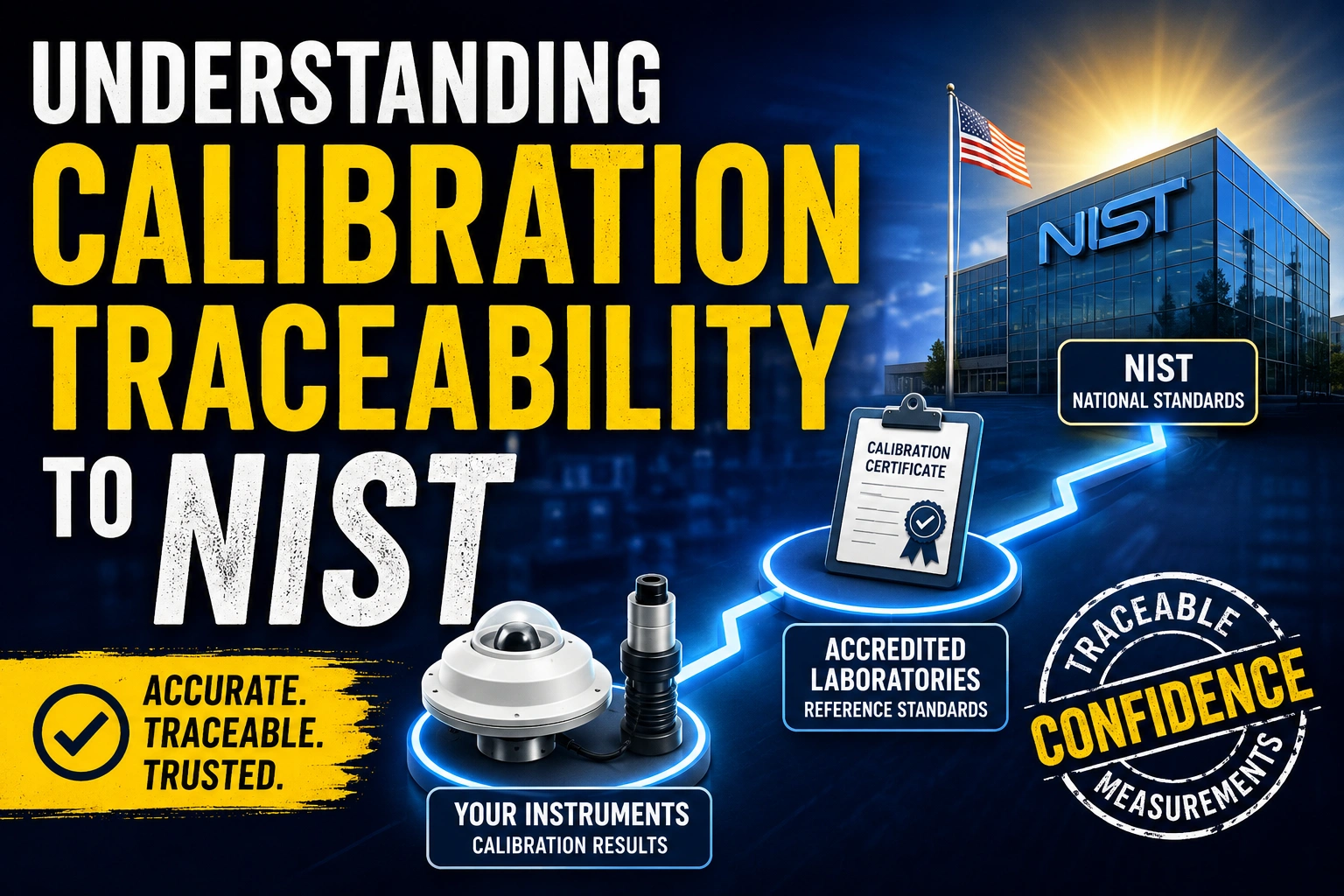
Think of calibration traceability as a chain.
Level 1: NIST Primary Standards
At the top are primary standards maintained by NIST.
These standards establish the national reference for measurements such as:
- Temperature
- Electrical measurements
- Optical radiation
- Solar radiation
- Heat flux
Level 2: Accredited Calibration Laboratories
ISO/IEC 17025 accredited laboratories maintain highly accurate reference instruments that are periodically calibrated against national standards or recognized transfer standards.
Facilities like ISO-CAL North America use these reference instruments to calibrate customer equipment while maintaining documented traceability throughout the calibration process.
Learn more about ISO/IEC 17025 accreditation in our article Definition and Importance of ISO 17025.
Level 3: Customer Instruments
Finally, customer instruments—including:
- Pyranometers
- Pyrheliometers
- Heat Flux Sensors
- Gardon Gauges
- Schmidt-Boelter Gauges
- PAR Sensors
are calibrated against laboratory reference standards.
The calibration certificate documents this complete chain of traceability.
Why Traceability Matters
Traceability provides confidence that measurements are accurate, repeatable, and comparable regardless of where they are performed.
Without traceability:
- Measurement accuracy cannot be verified.
- Results from different laboratories may disagree.
- Long-term measurement trends become unreliable.
- Regulatory compliance becomes difficult.
For industries where precision matters, traceability is not optional—it is essential.
Traceability and ISO/IEC 17025
Many people assume ISO 17025 and NIST traceability are the same thing.
They are closely related—but not identical.
ISO/IEC 17025 establishes requirements for calibration laboratories, including:
- Technical competence
- Documented procedures
- Equipment maintenance
- Personnel qualifications
- Measurement uncertainty
- Calibration traceability
In other words, ISO 17025 requires laboratories to maintain traceability as part of their quality system.
If you’re unfamiliar with the differences between quality management and laboratory accreditation, see ISO 17025 vs. ISO 9001: Understanding Calibration Standards.
What Makes a Calibration Traceable?
A calibration is considered traceable when it includes:
Documented Calibration Procedures
Every calibration follows standardized procedures that can be reproduced consistently.
Known Measurement Uncertainty
Every step contributes uncertainty that is quantified and documented.
To learn more, read Understanding Measurement Uncertainty in Calibration Results.
Unbroken Chain of Comparisons
Every reference instrument has its own calibration certificate, creating a continuous chain back to national standards.
Competent Laboratory
The calibration must be performed by qualified personnel using validated methods and properly maintained equipment.
Traceability for Heat Flux Calibration
For heat flux sensors, traceability often begins with highly characterized reference instruments and controlled radiation sources.
Calibration laboratories compare customer sensors against these reference standards under carefully controlled conditions.
Factors influencing traceability include:
- Blackbody source performance
- Sensor alignment
- Temperature stability
- Environmental conditions
- Measurement uncertainty
Our article Blackbody Sources in Heat Flux Calibration Explained explains how stable radiation sources contribute to reliable traceable calibrations.
Traceability for Solar Radiation Instruments
Solar radiation instruments also depend on traceable calibration.
Examples include:
- Pyranometers
- Pyrheliometers
- Albedometers
- PAR Sensors
These instruments are calibrated against reference sensors that ultimately connect back to internationally recognized standards.
For example, our guide on Pyranometer Calibration Methods Explained: ISO 9847 vs. ISO 9060 explains how standardized calibration methods support consistent solar radiation measurements worldwide.
Common Misconceptions About NIST Traceability
“NIST calibrated my sensor.”
Usually not.
Most instruments are calibrated by accredited laboratories—not directly by NIST.
“Traceable means perfect.”
No calibration is perfect.
Every measurement contains uncertainty, which is documented on the calibration certificate.
“Manufacturer calibration is enough.”
Factory calibration may establish initial performance, but regular recalibration is necessary to maintain measurement confidence over time.
If you’re unsure when recalibration is needed, read Signs Your Pyranometer Needs Calibration.
What Should a Traceable Calibration Certificate Include?
A high-quality calibration certificate should contain:
- Instrument identification
- Calibration date
- Environmental conditions
- Calibration method
- Measurement results
- Measurement uncertainty
- Statement of traceability
- Reference standards used
- Technician or laboratory approval
These details provide the documentation necessary for audits, quality management systems, and long-term measurement confidence.
Maintaining Traceability Over Time
Traceability is not permanent.
To maintain confidence in your measurements:
- Follow recommended calibration intervals.
- Store instruments properly to prevent damage or drift.
- Review calibration certificates after each service.
- Monitor measurement trends for unexpected changes.
- Work with laboratories accredited to ISO/IEC 17025.
Proper maintenance, combined with regular calibration, helps ensure your measurements remain reliable throughout the life of the instrument.
Final Thoughts
Calibration traceability to NIST is the foundation of trustworthy measurement. Rather than simply indicating that an instrument has been calibrated, traceability demonstrates that every measurement can be connected through a documented chain of comparisons back to nationally recognized standards.
Whether you’re measuring solar irradiance, thermal radiation, or heat flux, maintaining traceability helps ensure consistency, supports ISO/IEC 17025 compliance, and provides confidence that your data can be trusted.
By understanding how traceability works—and partnering with an accredited calibration laboratory—you can make informed decisions based on accurate, defensible measurement data.